




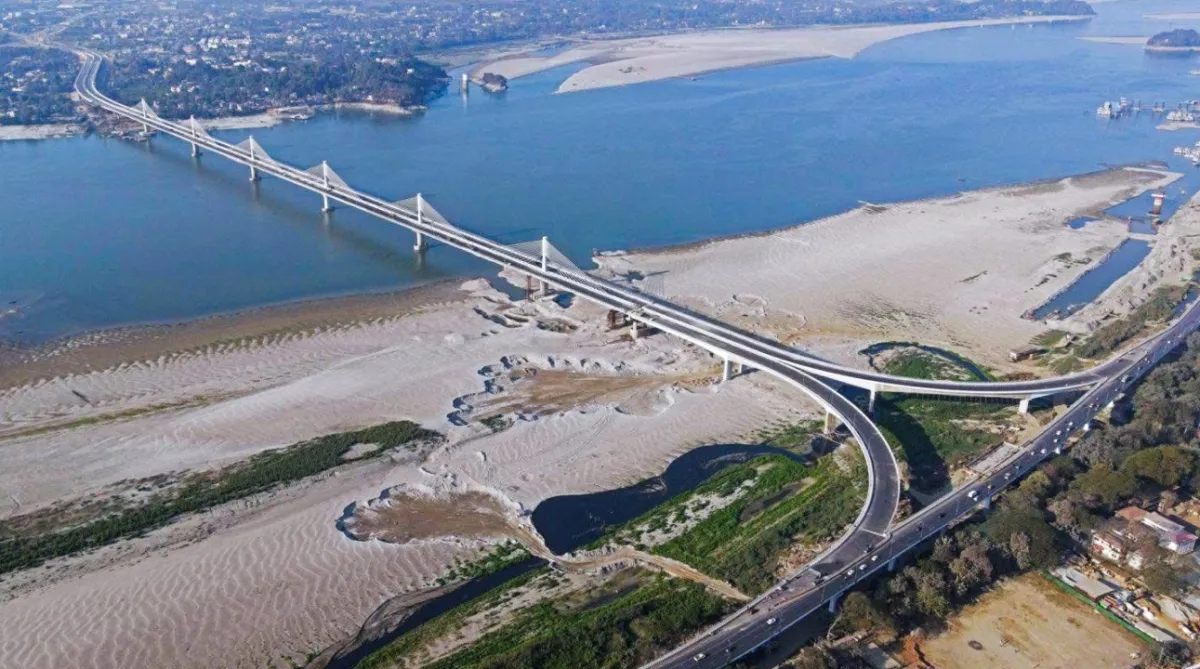
For decades, the story of Guwahati has been a tale of two banks—the bustling, high-density South and the serene, historically rich North—separated by the mighty Brahmaputra and a commute that often felt like a journey between two different time zones. On February 14, 2026, that narrative changed forever.
With the inauguration of the Kumar Bhaskar Varma Setu by Prime Minister Narendra Modi, Guwahati has not just gained another bridge; it has unlocked a new era of urban mobility, economic integration, and architectural pride.
An Engineering Marvel in the Heart of Assam
The new six-lane bridge, connecting Bhutnath (South Guwahati) to Gauripur (North Guwahati), is a spectacular addition to the city’s skyline. But its beauty is more than skin-deep.
Constructed at a cost of approximately ₹3,030 crore, the 1.24-km main structure is the Northeast’s first extradosed bridge. For the uninitiated, an extradosed design is a sophisticated hybrid between a girder bridge and a cable-stayed bridge. This allows for longer spans and a lower tower height compared to traditional cable-stayed bridges, making it exceptionally sturdy against the seismic vulnerabilities of Zone 5, which Assam famously occupies.
Engineers from SPS Construction India employed cutting-edge friction pendulum bearing technology to ensure the bridge can withstand major earthquakes—a first for a project of this scale in India.
From 60 Minutes to 7: The Great Time Collapse
Perhaps the most tangible impact for the common citizen is the “time collapse.” Until now, the commute between the two banks relied on the aging Saraighat Bridge or the rhythmic but unpredictable ferry services. During peak hours, navigating the traffic snarls at Jalukbari or Adabari could take anywhere from 45 to 90 minutes.
With the opening of the Kumar Bhaskar Varma Setu, that same journey is now a breeze, clocking in at a mere 7 to 10 minutes. For the thousands of students at IIT Guwahati, professionals working in the city, and patients seeking medical care at the North Guwahati health hubs, this isn’t just a convenience; it is a life-changing development.
The Twin-City Vision: North Guwahati’s Renaissance
The bridge is the cornerstone of the Assam government’s vision to develop North Guwahati as a “Twin City.” With the Guwahati High Court and several key administrative offices slated to shift northward, the bridge acts as the umbilical cord for this expansion.
Beyond administration, the bridge holds immense spiritual and cultural significance. As the Prime Minister noted during the inauguration, the bridge will provide devotees with seamless access to the Kamakhya Temple, further boosting the state’s religious tourism circuit.
A Symbol of Identity
Named after the 7th-century monarch of the Varman dynasty, Kumar Bhaskar Varma—the most illustrious ruler of the ancient kingdom of Kamarupa—the bridge bridges the gap between Assam’s glorious past and its high-tech future.
As night falls, the bridge transforms into a beacon of light. Equipped with a dynamic lighting system capable of displaying thematic colors (such as the Tricolour on Republic Day), it is already being hailed as Guwahati’s answer to Kolkata’s Howrah Bridge—a new urban symbol that defines the city’s modern identity.
Challenges and the Road Ahead
The journey to completion wasn’t without hurdles. From the shifting channels of the Brahmaputra and the fury of annual monsoons to the logistical nightmare of the COVID-19 pandemic, the project saw its share of delays and cost escalations. There are also ongoing discussions regarding the toll system for heavy vehicles and the completion of the trumpet junction at Gauripur.
However, as vehicles glide across the smooth six-lane expanse, those challenges seem like a small price for the progress achieved.
The Kumar Bhaskar Varma Setu is more than just steel, concrete, and cables. It is a testament to what modern engineering can achieve in one of the world’s most challenging riverine terrains. As Guwahati expands its footprint, this bridge stands as a silent witness to a city that is no longer content with its historical boundaries, but is reaching across the water to claim its future.
For the residents of Guwahati, the “other side” has never felt closer.